Wednesday, July 9, 2008

Bus stops are good.

I passed this nifty little structure on my way to a student's house. In my own neighborhood, kids don't tend to meet in one place to wait for the bus, so the bus stops every 15 feet or so to take on passengers. If I happen to be stuck behind the bus, I yell at my windshield, c'mon kids, walk! That's what feet are for!

But I'm not being fair, because at least these kids (well, their parents) are taking advantage of public transportation. They don't add to the congestion everywhere within a two mile radius of the schools during drop-off and dismissal.

I won't slide into a rant about SUV Moms cutting people off to get their one and a half children into or out of the school parking lot. Or about the cops stopping traffic to let those SUVs in and out. Because that would be a cliché. Complaining about SUV Moms is so yesterday (not to be confused with regular moms, about whom, in general, I do not complain).

No. This post is about bus stops. My childhood bus stop was just a corner; not even a sign indicated that anything special might happen if you waited there. Everyone just knew where it was. My little sister Amy and I lived three blocks from it, which wasn't bad. Unfortunately, the last block was a steep hill. Amy had a strangely charming laziness about her that translated into, among many other quirks, an inability to get herself up that last hill to the bus stop. Every morning, weighed down with textbook-filled backpacks (those books are online now), we trudged up the hill. Amy would start to fall back, and I'd grab her hand and pull her. We'd see the bus rolling into the stop, which meant we had about 90 seconds, if we were lucky, to catch that bus. So I'd take Amy's backpack and swing it onto my back on top of my own, and with my right hand I would push that kid up the hill.

If we missed the bus, we walked—which stunk. But at least we could walk, and what a stinkin' luxury that was.

Tuesday, July 8, 2008

A strip mall with a view

Like many rural suburban U.S. towns, mine—at its core—is a tangle of strip malls coalescing around a center. Surrounding that is a cat's cradle of wooded dirt roads dotted with 19th century farmhouses and cottages, and paved roads lined with 20th century capes and raised ranches. Fused to these are sparkling subdivisions named Dogwood Bridge Acres and Cedar Circle Woods, more than a few of which will soon devolve into Sub-Prime Mortgage Meadows and Foreclosure Sunset Farms (bringing the rest us down with them, thank you so much).

The center of our town is marked by a 100-foot flagpole, erected in 1876. Sidewalks lead in four directions from the pole. The sidewalks remind me of Shel Silverstein's Where the Sidewalk Ends. At age six or so, I remember thinking: what a funny and absurd notion--a sidewalk, ending? Sidewalks don't end! The Earth is round!

They end in my town. They pick up again, anemically, at various points in the Commercial District. But they don't lead anywhere in particular (I don't count the banks, nail salons, or the CVS). People feel sorry for pedestrians here. Look at that guy! Why is he walking? Should we call it in? Maybe he's stranded.

Even in my car, I sometimes feel stranded. Yet, I've grown accustomed to this life. It's comfortable. The truth is that when I visit my home city, I often can't wait to get back. What does that say about the suburbs? About me? Hm.

Sunday, July 6, 2008

An old coal silo in Beacon, NY


From the looks of things, people are starting to use coal again.

Thursday, July 3, 2008

I'm too distracted by the post on

Emily Magazine to write anything worthwhile. Jeeezus.

Instead, tonight's entertainment here on Kidless will be provided by Koko. If we could all just be that happy. Or bored.


Wednesday, July 2, 2008

This is the center of my town.

Does it look like a parking lot to you? Yeah, to me too. But it’s what the local teenagers refer to as “The Center.” I tutor for a living, so I meet a lot of teenagers. For a while I thought that they were talking about the intersection on Main Street, which sports a whopping big flagpole. There’s a bucolic little general store just down the road from it where you can get sodas and ice cream. But now that I think of it, I’ve rarely seen kids hanging out there. Then I thought that they must be referring to the teen center run by the town. But I’m not that far into adulthood (okay, yes I am but) to believe that any self-respecting teen would set an Old Skool Vans-encased foot into a place created for kids by adults.

My boss finally explained it to me. The Center is the CVS parking lot. Riiiight, of course! I always have to watch my rear view mirror with extra vigilance when pulling out of the CVS lot to make sure that I don’t hit any of those…kids. What are they doing there? They can’t drink or do drugs or even make out—what with all those adults milling about, shopping. They can smoke, however, because apparently while one must be 18 in my state to purchase cigarettes, the law permits people to smoke at the age of 16...as long as someone else buys them. One of my students told me that. Okay, so they can smoke at the CVS. What else? There’s a Big Y next door (that’s a supermarket around these parts), with a much bigger parking lot. But they don’t congregate there. Is CVS cooler than the Big Y?

I grew up in Brooklyn and spent most of my free time wandering the streets of Manhattan. Yeah, I’m showing off, being superior. But when I mention this to my students, they look at me with awe. It’s like saying that I was the batboy for the Yankees, or went to high school with Jennifer Aniston (actually, I did—she was a year ahead of me. But telling people that would be plain obnoxious).

Call me an idealist, but I don’t think it’s good that the CVS parking lot will figure so heavily in these kids’ memories of childhood. Here’s the question: how does a semi-rural suburban town create something for the kids to do, a place for them to go, without adultifying it and thereby making it uncool and verboten? Even if the town council put together a team of teenagers to come up with something, the very fact that adults had initiated it would probably have the same chilling effect.

Anyone?

Tuesday, July 1, 2008

Emily Gould is to me as

Liz Phair is to Emily Gould. Sort of. In her June 26th post in Emily Magazine, Emily wrote that she loves Liz Phair. She mused that it's a strange and embarrassing thing to love someone who doesn't know her. Well, let's not go crazy, I can hear my husband saying. Okay, fine. Maybe love is a strong word to describe how I feel about Emily. But I have my reasons. And she has hers for loving Liz Phair.

About eight months ago I started this blog out of desperation. I didn't really understand the blog world, with its nuances and idiosyncrasies. Or, really, why people blogged. I was in a downward spiral and needed to talk to someone. But I couldn't talk. So I started to write in this blog. At the time, I called it "My Anomie." I wrote for a short while, a week or so, about my deepening sense of isolation and lack of place in the world. Things got worse, and then everything stopped.

Zoom forward to Emily's article "Exposed," which came out in the May 25th issue of The New York Times Magazine, with the subhead, "What I gained — and lost — by writing about my intimate life online." I read it without stopping. It was so insightful, and honest, and unpretentious. Instead of a sensational self-exposé, I found in her story an explanation of Emily's specific cross-section of the internet generation. Of the personal blog that eventually led to her very public vilification, she wrote,

"I’m willing to let that blog exist now as a sort of memorial to a time in my life when I thought my discoveries about myself and what I loved were special enough to merit sharing with the world immediately.”

The blog Emily refers to, which I won't name here but is easy enough to find, still exists. However, its infamous archives are closed to the public. She learned the very hard way what not to do in the blogosphere—overshare (as she put it), and what to do—think (for at least a minute) before hitting "publish." I learned the easy way—from reading her article.

Emily is still blogging away in Emily Magazine, fiercely and humorously but not foolishly. And so, I believe, am I here in Kidless. It's fun and uniquely satisfying to share my thoughts and images with whoever might be out there. I thank Emily for explaining this new world to me.

And that's why I love her.

Think.

Publish.

I want the world to know


that I submitted a story to a contest last night. I checked my log and discovered that the last time I submitted anything was December '07. My rejection slip folder must be getting dusty. Contest results will be announced August 31st. I won't say which magazine it is because I don't want anyone who might stumble upon this post to get any ideas about adding to the competition. I have sunk that low.

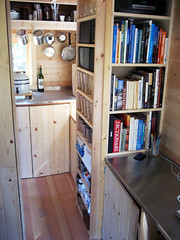
Desk, Bookcase, and the Kitchen Beyond


Desk, Bookcase, and the Kitchen Beyond Originally uploaded by Telstar Logistics


This is a shot of the inside of Jay Shafter's home. It's 100 square feet. My palace will be 2.5 times bigger. Imagine the possibilities...

According to Tumbleweed, the Loring actually has 400 square feet of usuable living space, once you include the loft (which isn't considered inhabitable because of the low ceiling but can certainly hold a bunch of my stuff). And the cost? Jay says that the price to build comes in between $100-200 per square foot. Let's split it and say $150, so...it'll cost approximately $37,650. Not sure if I have to count the loft footage but this is my fantasy, so I'll say no to that.

It will be like Walden, only not in the woods.

I'm pale green at best, but

I love the idea of having this simple, low-impact, low-cost life. My (future) tiny house sits on a tenth of an acre in a cool little town. With the house only covering 251 square feet, I have room for a front walk and backyard garden. The garden provides me with tomatoes, eggplant, peppers, basil, and catmint (for Katie). The property is small enough that it's not overwhelming to tend it. While I'm fantasizing, let's put one of Solar Lab's solar-powered rickshaws in a pint-sized car port along side the house. The drawing above is from an article in Inhabitat, TRANSPORTATION TUES: Solar-Power Rickshaws for London by Mahesh Basantani.

Solar-Power Rickshaws for London

And once I get my tiny house, this will be my transportation.

read more | digg story